

Introduction: Listening to the Universe’s Most Violent Events
For millennia, human understanding of the cosmos was limited to the light we could detect—visible light, radio waves, X-rays—essentially relying on the universe’s visual performance to tell its story. However, the most profound and violent events in the cosmos, such as the destructive merging of black holes or the explosive death of massive stars, often occur in regions shrouded by gas and dust, or involve entities that, by their very nature, emit no light whatsoever. The scientific world recognized that to truly comprehend the universe’s dramatic hidden history, a completely new sensory modality was required, something that could penetrate the visual darkness and convey the raw power of gravity itself. This quest led to the theoretical prediction, and eventual detection, of gravitational waves, which are not a form of electromagnetic radiation but ripples in the very fabric of spacetime itself.
The confirmation of gravitational waves in 2015 by the Laser Interferometer Gravitational-Wave Observatory (LIGO) inaugurated the era of gravitational-wave astronomy, fundamentally revolutionizing our understanding of the universe’s physics and providing an unparalleled window into its most exotic phenomena. These faint, fleeting echoes are literally the sounds of cosmic titans colliding, primarily the spiraling and merging of immense black holes. By translating these ripples into audible ‘chirps,’ scientists can now listen to the universe, gathering information about the mass, spin, and velocity of objects that were previously invisible and inaccessible to all forms of light-based observation. This new ability to “hear” the universe’s most violent events confirms key predictions of Albert Einstein’s General Relativity and offers compelling new insights into the formation and evolution of black holes.
This extensive guide will delve into the intertwined nature of Black Holes and Gravitational Waves, explaining the physics behind these cosmic behemoths and the ripples they create. We will meticulously cover everything from the formation and properties of black holes and the mathematical framework of spacetime to the genius of the LIGO experiment and the groundbreaking discoveries made through these echoes of cosmic collisions. Understanding this field is key to appreciating the future of astronomy, where light and gravity work together to paint a complete picture of our dynamic and often turbulent cosmos.
1. The Physics of Black Holes: Cosmic Titans
Before exploring the waves they create, we must first understand the exotic nature of the objects themselves: black holes, regions of spacetime where gravity is so intense that nothing, not even light, can escape.
Black holes are the universe’s most efficient and mysterious gravity wells.
A. Formation from Stellar Collapse
The most common type of black hole is formed from Formation from Stellar Collapse. When a star roughly 20 to 30 times the mass of our Sun exhausts its nuclear fuel, it can no longer support itself against its own immense gravitational pull.
The star collapses inward, leading to a supernova explosion, and the remaining core compresses into an object of near-infinite density.
B. The Singularity
The compressed core forms The Singularity. This is the theoretical point at the very center of the black hole where matter is crushed to an infinitely small and dense point, and the known laws of physics cease to apply.
It is the point where the mathematical predictions of General Relativity break down completely.
C. The Event Horizon
Surrounding the singularity is The Event Horizon. This is the boundary or point of no return; anything that crosses this surface, including light, is irrevocably captured by the black hole’s gravity.
The event horizon’s radius is directly proportional to the black hole’s mass.
D. Measuring Mass and Spin
Black holes are primarily defined by only two observable properties: Measuring Mass and Spin. They possess no other features (like size or composition) once they are fully formed.
The spin is measured by the speed at which the singularity rotates, dragging the spacetime around it.
E. Supermassive Black Holes
Beyond the stellar variety, there are Supermassive Black Holes. These behemoths can be millions or even billions of times the Sun’s mass and are believed to reside at the center of nearly every large galaxy, including our own Milky Way.
The growth mechanisms for these colossal black holes are still a major area of research and debate among astrophysicists.
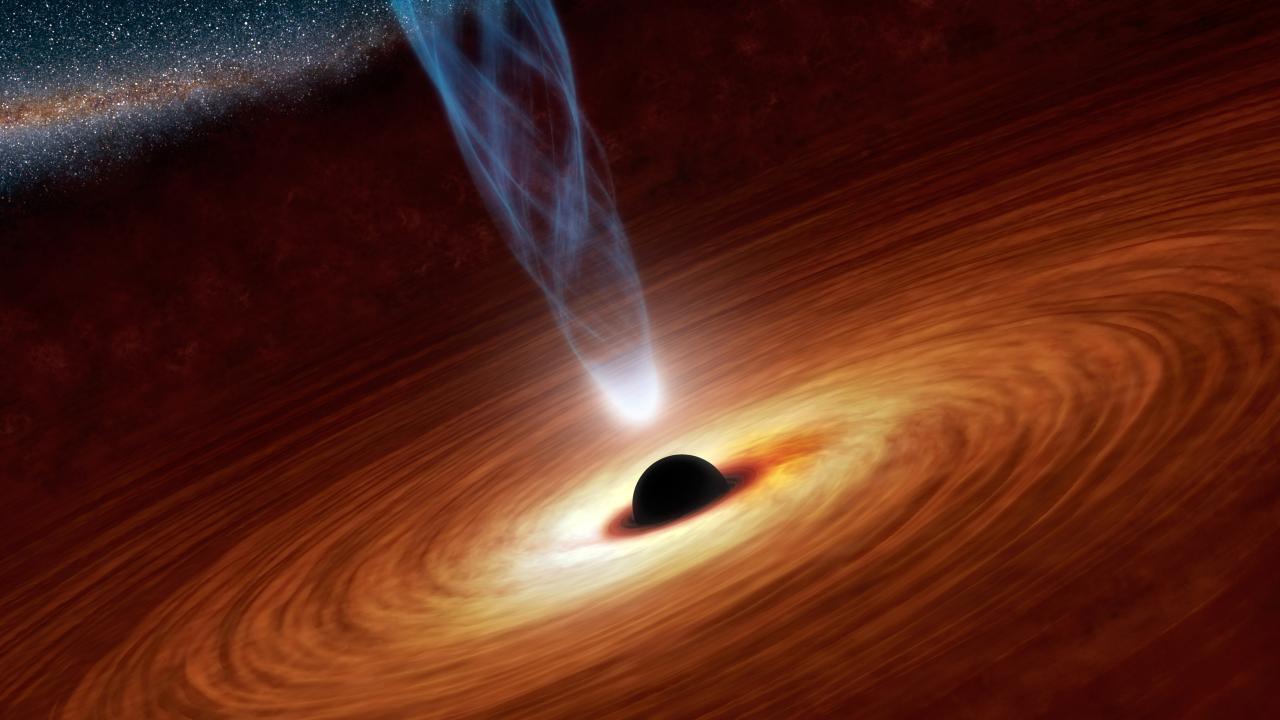
F. Accretion Disks
Most black holes are surrounded by Accretion Disks. This is a swirling vortex of gas, dust, and plasma pulled in by the black hole’s gravity but not yet crossing the event horizon.
Friction within the disk heats the material to millions of degrees, causing it to emit intense X-rays and visible light.
G. Relativistic Jets
Often associated with supermassive black holes are powerful Relativistic Jets. These are highly collimated beams of plasma ejected from the poles of the black hole at nearly the speed of light.
These jets are thought to be powered by the strong magnetic fields generated by the spinning accretion disk.
H. No-Hair Theorem
The properties of black holes are constrained by the No-Hair Theorem. This theorem states that a black hole is completely characterized by just its mass, electric charge, and angular momentum (spin).
The theorem implies that no other information, or “hair,” about the matter that formed the black hole can be observed once it has crossed the event horizon.
2. General Relativity and the Fabric of Spacetime
The existence of both black holes and gravitational waves is a direct consequence of Albert Einstein’s groundbreaking theory, which fundamentally redefined gravity not as a force, but as a geometrical property.
Gravity is the geometry of the universe, and mass is the architect.
I. Gravity as Spacetime Curvature
Einstein defined Gravity as Spacetime Curvature. He proposed that mass and energy warp the fabric of spacetime, a four-dimensional manifold combining the three dimensions of space and one dimension of time.
Objects then follow the shortest path through this curved geometry, which we interpret as the force of gravity pulling them.
J. Motion on Geodesics
Objects in space, such as planets orbiting a star, are engaging in Motion on Geodesics. A geodesic is the shortest possible path between two points within a curved space.
Planets are simply following the curves and contours created by the Sun’s immense mass in the spacetime fabric.
K. The Wave Equation Prediction
General Relativity included The Wave Equation Prediction in its mathematics. Einstein predicted that a massive object that accelerates or moves non-spherically would generate ripples that propagate outward at the speed of light.
These traveling disturbances in the curvature of spacetime are the gravitational waves.
L. Energy Loss through Radiation
Any spiraling or accelerating massive object experiences Energy Loss through Radiation. As two black holes orbit each other, they shed orbital energy in the form of gravitational waves.
This energy loss causes their orbit to decay, slowly drawing them closer together until they merge.
M. The Quadrupole Moment
Gravitational wave emission requires a change in the The Quadrupole Moment of the system. This means that a spherically symmetrical object expanding and contracting does not radiate waves.
Only systems with changing, non-spherical mass distributions, like orbiting binaries, are powerful emitters.
N. The Speed of Gravitation
General Relativity established The Speed of Gravitation as finite, traveling at the speed of light ($c$). Previously, Newtonian mechanics assumed gravity acted instantaneously across vast distances.
The speed of the waves is crucial because it allows for triangulation and precise timing of cosmic events across the universe.
O. Tidal Forces
The wave itself exerts Tidal Forces on detectors. As a gravitational wave passes, it alternately stretches and compresses space perpendicular to the direction of propagation.
This is the minute effect that sensitive instruments like LIGO are designed to measure.
3. Detecting the Ripples: The LIGO Experiment
For decades, gravitational waves were a theoretical concept, considered too faint to ever be detected. The sheer ingenuity and precision of the LIGO and Virgo collaborations finally made the impossible a reality.
LIGO is the most sensitive scientific instrument ever built, designed to detect infinitesimal ripples.
P. The Principle of Interferometry
LIGO operates based on The Principle of Interferometry. It uses L-shaped detectors with arms several kilometers long, sending a laser beam down each arm and monitoring the interference pattern when the beams recombine.
A passing gravitational wave infinitesimally stretches one arm while squeezing the other, changing the path length and shifting the interference pattern.
Q. The Scale of the Detection
The detection operates at The Scale of the Detection of motion smaller than one ten-thousandth the diameter of a proton. The change in the arm length is incredibly tiny, demanding extreme environmental isolation.
This phenomenal sensitivity makes LIGO susceptible to all sorts of noise, requiring multiple detectors and advanced filtering.
R. The First Discovery (GW150914)
The collaboration made The First Discovery (GW150914) in September 2015. This signal, generated by the merger of two stellar-mass black holes, was a perfect match for the predictions of General Relativity.
The merger confirmed both the existence of black holes and the reality of gravitational waves, a century after Einstein’s prediction.
S. Global Detector Network
The accuracy of detection relies on a Global Detector Network. By using multiple detectors (LIGO in the US, Virgo in Italy, KAGRA in Japan), scientists can use triangulation to accurately pinpoint the source location in the sky.
Simultaneous detection in distant locations confirms the signal is truly astrophysical and not local noise.
T. The Signature Chirp
The resulting data produces The Signature Chirp. As the two black holes spiral inward, their orbital frequency increases, causing the gravitational wave frequency to rise sharply until the moment of merger, creating an audible “chirp.”
Analyzing the characteristics of this chirp yields precise measurements of the merging objects’ masses and spins.
U. Noise Cancellation Techniques
LIGO employs sophisticated Noise Cancellation Techniques. Everything from seismic vibrations and passing trucks to thermal fluctuations and even quantum noise must be meticulously filtered out.
The mirrors in the detectors are suspended by complex systems designed to isolate them from Earth’s constant motion.
V. Calibration and Data Validation
Rigorous Calibration and Data Validation are continuous. Scientists must be absolutely certain that the detected signals are astrophysical in origin and not instrumental artifacts.
Every chirp is checked against thousands of simulations generated using Einstein’s equations.
4. The Cosmic Collisions: Sources of Gravitational Waves
Gravitational-wave astronomy has opened up new catalogs of cosmic events, revealing mergers involving not only black holes but also neutron stars and entirely new classes of exotic events.
The most extreme events in the universe are now becoming observable phenomena.
W. Binary Black Hole Mergers
The most common events are Binary Black Hole Mergers. Since the 2015 breakthrough, dozens of these mergers have been detected, revealing a population of black holes with masses previously unexpected by stellar evolution models.
These discoveries challenge previous assumptions about how heavy stars end their lives.
X. Binary Neutron Star Mergers
A monumental observation was made with Binary Neutron Star Mergers (GW170817). The merger of two neutron stars was detected in both gravitational waves and electromagnetic light (gamma-rays, X-rays).
This multi-messenger astronomy confirmed that these mergers are the primary cosmic factories for creating heavy elements like gold and platinum.
Y. Black Hole and Neutron Star Pairings
LIGO has also detected Black Hole and Neutron Star Pairings. These mergers provide crucial information on the extreme physics governing the death throes of binary star systems.
Such events allow scientists to probe the matter that makes up the neutron star just moments before it is consumed by the black hole.
Z. Intermediate-Mass Black Holes
Observations hint at the existence of Intermediate-Mass Black Holes (IMBHs). Some detected merger remnants have masses between 100 and 100,000 solar masses, filling a long-standing gap in black hole size classifications.
These IMBHs are too large to form from a single star collapse, suggesting complex formation mechanisms like multiple black hole mergers.
AA. Kilonova Explosions
The collision of two neutron stars leads to a violent Kilonova Explosion. This event is brighter than a standard nova and is powered by the rapid decay of radioactive heavy elements created during the merger.
The observation of kilonova light alongside gravitational waves was a crucial validation of stellar nucleosynthesis theories.
BB. Asymmetric Mergers
Analysis of the waves reveals Asymmetric Mergers. When two black holes of unequal mass merge, the resulting gravitational wave emission is complex, causing the remnant black hole to recoil or “kick” away at high velocity.
These kicks can eject the newly formed black hole from its host galaxy entirely.
5. New Insights and Future Frontiers
The data gathered from these cosmic echoes is not only confirming old theories but is also actively revealing new aspects of physics, from the expansion rate of the universe to the nature of dense matter.
Gravitational waves are unlocking deeper secrets about the universe’s history and fundamental laws.
CC. Measuring the Hubble Constant
Gravitational waves offer a completely independent method for Measuring the Hubble Constant. By using neutron star mergers as “standard sirens” (sources of known gravitational wave energy), scientists can calculate cosmic distances without relying on light-based calibrations.
This independent measurement helps resolve the current discrepancy between different methods of measuring the universe’s expansion rate.
DD. Probing Neutron Star Equation of State
Neutron star mergers are powerful tools for Probing Neutron Star Equation of State. The way a neutron star deforms just before it merges reveals crucial details about the state of matter under extreme pressure and density, information impossible to get on Earth.
This research helps determine the maximum possible mass a neutron star can sustain before collapsing into a black hole.
EE. Future Space-Based Detectors (LISA)
The next great leap is Future Space-Based Detectors (LISA). The Laser Interferometer Space Antenna will detect lower-frequency waves that originate from the mergers of supermassive black holes at the centers of colliding galaxies.
LISA’s range of detection will allow scientists to see these mergers when the universe was much younger.
FF. Testing General Relativity Limits
The observations are constantly Testing General Relativity Limits. By comparing the detailed chirp signals with Einstein’s predictions, scientists can search for tiny deviations that might hint at new physics.
Every new merger provides a crucial data point to confirm or refine our fundamental understanding of gravity.
GG. Gravitational Wave Background
The future involves searching for the Gravitational Wave Background. This is a potential low-frequency, persistent hum of gravitational waves originating from all the mergers and violent events that occurred throughout the universe’s history.
Detection of this background would open a window onto the very first moments of the cosmos.
HH. Dark Siren Cosmology
A novel technique is Dark Siren Cosmology. This uses the gravitational waves from black hole mergers (which have no light counterpart) alongside statistical methods to help constrain cosmological parameters like the Hubble Constant.
Even without a light signal, the wave data provides valuable information about cosmic distances.
Conclusion: New Senses, Deeper Understanding
The detection of gravitational waves has gifted humanity an entirely new sense, allowing us to “hear” the cataclysmic echoes of cosmic collisions and fundamentally change our perception of the dynamic universe. These ripples are the direct result of Einstein’s theory that gravity is spacetime curvature, caused by the extreme mass of objects like black holes.
The incredible precision of the LIGO experiment confirmed these waves, opening a powerful new window into the universe. The analysis of the signature chirp from merging binaries provides unparalleled measurements of mass and spin. Future space-based detectors like LISA promise to extend our hearing to the deepest reaches of space and time.

