

Introduction: The Incomplete Inventory of the Cosmos
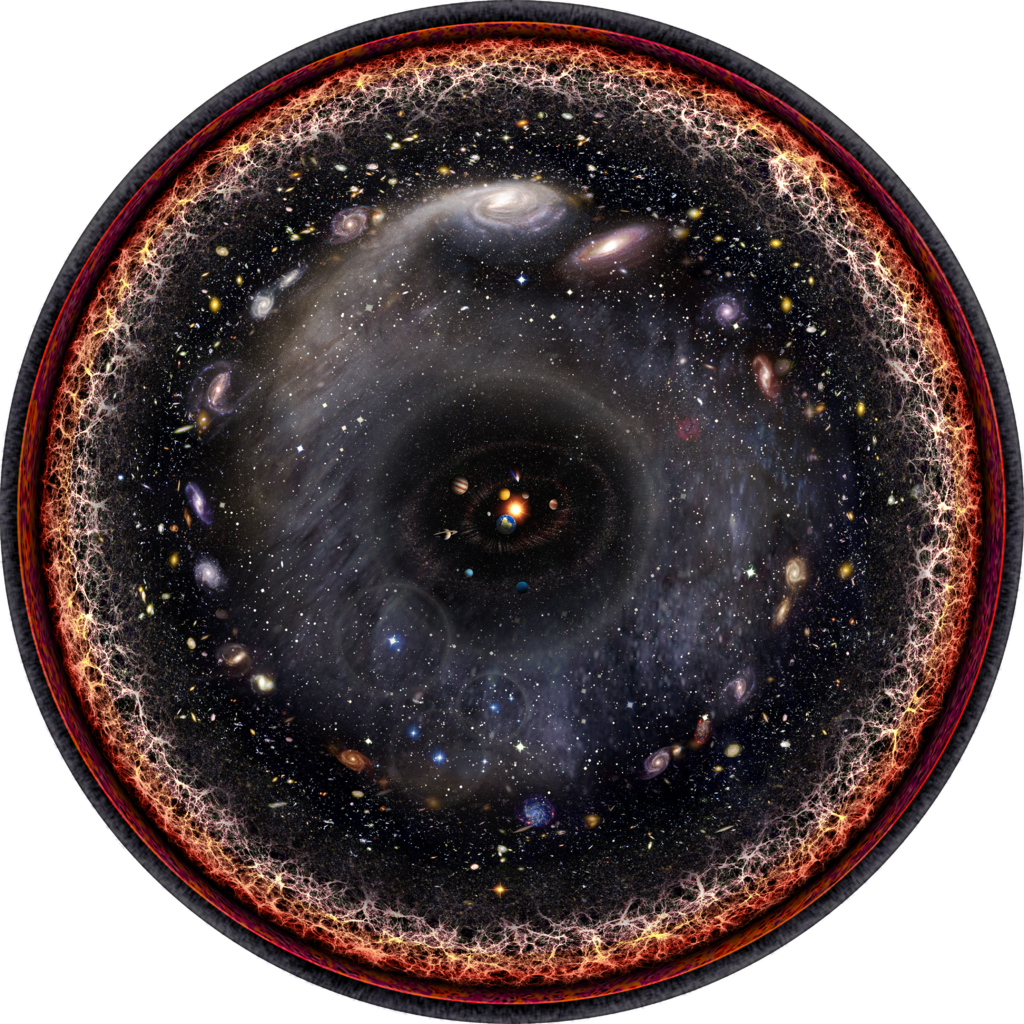
Imagine taking a complete inventory of a vast, sprawling warehouse, only to discover that 95% of the goods you know must be there are completely invisible and defy all attempts at direct detection. This is the profound dilemma facing modern cosmology, where observations of the cosmos reveal a staggering discrepancy between the amount of matter and energy we can see and the amount required to explain the motions and structure of the universe itself. According to our most precise measurements, all the atoms, stars, planets, and galaxies—everything that interacts with light and forms the subject of traditional astronomy—constitutes only a paltry 5% of the total mass-energy content of the universe. The remaining 95% is composed of two mysterious, unseen components: Dark Matter and Dark Energy, two concepts that represent the biggest, most persistent puzzles in all of physical science.
The existence of these two “dark” components is not a theoretical speculation but a necessary conclusion drawn from multiple, independent lines of evidence, including the rotation rates of galaxies, the bending of light around massive clusters, and the geometry of the early universe. Dark Matter acts as an unseen gravitational glue, providing the necessary extra mass to hold galaxies and clusters together, preventing them from flying apart. Dark Energy, on the other hand, acts as a cosmic antigravity, pushing spacetime apart and accelerating the expansion of the universe in a way that defies conventional physics. Without these two elusive components, our models of cosmic evolution, from the Big Bang to the present day, simply fall apart, leaving us with a universe that is mathematically unsound and physically unstable.
This vast, unobserved majority of the cosmos dictates its destiny, shapes its structure, and drives its ultimate fate, yet its nature remains almost entirely unknown. This extensive guide will demystify the concepts of Dark Matter and Dark Energy, explaining the definitive evidence that necessitates their existence and detailing the intense, global efforts to finally unmask these universe’s missing pieces. We will delve into everything from galactic rotation curves and the powerful concept of gravitational lensing to the bizarre phenomenon of cosmic acceleration, charting the ongoing scientific quest to complete the cosmic inventory.
1. Dark Matter: The Gravitational Glue
Dark Matter is the pervasive, non-luminous substance that accounts for about 27% of the total mass-energy content of the universe, providing the gravitational scaffolding upon which galaxies are built.
Dark Matter ensures that galaxies spin and stick together rather than disintegrate.
A. The Galactic Rotation Problem
The primary evidence comes from The Galactic Rotation Problem. Astronomers observed that stars on the outer edges of spiral galaxies orbit just as quickly as stars near the center.
According to Newtonian physics and the visible mass, the outer stars should orbit much slower, indicating that significant unseen mass must be distributed throughout the galactic halo.
B. Gravitational Lensing
Powerful evidence is provided by Gravitational Lensing. The immense, unseen mass of galaxy clusters bends the light from background galaxies, creating distorted, magnified, or multiple images.
The amount of light distortion confirms that the total mass of the cluster is far greater than the mass of the stars and gas visible to telescopes.
C. The Bullet Cluster Confirmation
The most compelling evidence is The Bullet Cluster Confirmation. This event involved the collision of two galaxy clusters where the visible gas (hot plasma) slowed down in the middle, while the invisible mass passed straight through.
This clear separation between the gravitational mass (dark matter) and the baryonic mass (visible matter) proves that dark matter exists and interacts only gravitationally.
D. Dark Matter Halos
The visible galaxies are embedded within vast, spherical structures called Dark Matter Halos. These halos extend far beyond the visible boundaries of the galaxy, providing the dominant gravitational force.
The halo’s gravitational influence is what shapes the formation and clustering of all visible structures.
E. Constraints on Dark Matter Composition
Observations place strong Constraints on Dark Matter Composition. It must be non-baryonic (not made of protons and neutrons) and non-interacting with electromagnetic radiation (hence, dark).
It must also be “cold” or Cold Dark Matter (CDM), meaning its particles move relatively slowly, which is required to allow structures like galaxies to form.
2. The Search for the Dark Matter Particle
If Dark Matter is not made of regular atoms, it must be composed of a new, yet-to-be-discovered fundamental particle. The search for this particle is a major endeavor in particle physics.
Finding the particle will confirm the missing piece in our fundamental understanding of matter.
F. Weakly Interacting Massive Particles (WIMPs)
The historical leading candidate was Weakly Interacting Massive Particles (WIMPs). These hypothetical particles would be much heavier than a proton and interact only through gravity and the weak nuclear force.
WIMPs are predicted by many extensions to the Standard Model of particle physics, making them a theoretically appealing solution.
G. Direct Detection Experiments
The search for WIMPs involves Direct Detection Experiments. Massive, sensitive detectors are buried deep underground to shield them from cosmic rays and are designed to register the tiny energy signal if a WIMP strikes an atomic nucleus.
XENONnT and LUX-ZEPLIN are examples of such detectors searching for these rare interactions.
H. Indirect Detection Experiments
Another approach is Indirect Detection Experiments. These experiments search for the annihilation byproducts that occur when two WIMPs collide and destroy each other, potentially producing gamma rays or neutrinos.
Telescopes like the Fermi Gamma-ray Space Telescope look for these tell-tale annihilation signals emanating from dense dark matter regions, such as the center of the Milky Way.
I. The Axion Candidate
A strong alternative is The Axion Candidate. Axions are much lighter than WIMPs and are proposed to resolve another puzzle in physics related to the strong nuclear force.
Experiments like ADMX (Axion Dark Matter Experiment) use powerful magnetic fields to attempt to convert axions into detectable photons.
J. Sterile Neutrinos
Another potential particle is the Sterile Neutrinos. Unlike the three known types of neutrinos, these would not interact via the weak nuclear force, making them “sterile” and fitting the dark matter profile.
Sterile neutrinos are a type of Warm Dark Matter which moves faster than CDM and would have a distinct impact on small-scale structure formation.
3. Dark Energy: The Force of Cosmic Acceleration
Dark Energy is the most mysterious component, accounting for approximately 68% of the universe’s total mass-energy and driving the accelerated expansion of space itself.
Dark Energy is the ultimate cosmic force dictating the universe’s long-term fate.
K. The Supernova Evidence
The existence of Dark Energy was first confirmed by The Supernova Evidence in 1998. Two independent teams observed Type Ia supernovae (standard candles) in distant galaxies.
They discovered these supernovae were fainter and thus farther away than expected for a decelerating or coasting universe.
L. Cosmic Acceleration
This observation proved Cosmic Acceleration. The universe is not just expanding (as discovered earlier by Hubble), but the rate of its expansion is actively speeding up, defying the gravitational pull of all matter.
This requires an unseen, repulsive force—Dark Energy—to be present and dominant on the largest scales.
M. Equation of State
Dark Energy is characterized by its Equation of State. The pressure-to-density ratio ($w$) of Dark Energy determines its behavior.
A perfect vacuum energy (cosmological constant) has $w = -1$, meaning it exerts negative pressure, effectively causing repulsive gravity.
N. The Cosmological Constant
The leading theoretical candidate for Dark Energy is The Cosmological Constant ($\Lambda$). This idea, first proposed and later retracted by Einstein, suggests Dark Energy is the intrinsic, constant energy density of empty space itself.
As space expands, more “empty” space is created, and thus more Dark Energy is simultaneously created, driving the acceleration.
O. The Vacuum Energy Problem
Despite its elegance, the Cosmological Constant faces The Vacuum Energy Problem. When calculated using quantum field theory, the predicted energy density of the vacuum is $10^{120}$ times larger than the observed value.
This massive theoretical mismatch is the single largest quantitative disagreement between any theory and observation in the history of science.
4. Alternative Theories and Dynamic Dark Energy

Because of the massive theoretical challenges presented by the cosmological constant, physicists are actively exploring alternative models where Dark Energy is not constant but evolves over time.
Solving the Dark Energy puzzle may require a fundamental rewrite of General Relativity.
P. Quintessence
One alternative is Quintessence. This theory proposes that Dark Energy is a dynamic, evolving field that changes in time and space, rather than being a constant vacuum energy.
Quintessence would be associated with a particle known as a quintessence field, similar to the Higgs field.
Q. Modifying Gravity
Another approach is Modifying Gravity (Modified Newtonian Dynamics or MOND). This suggests that General Relativity itself breaks down at very large distances or very small accelerations.
By adjusting the mathematical rules of gravity, some models can explain the observed acceleration without invoking an entirely new form of energy.
R. Time-Varying Dark Energy
Ongoing experiments focus on tracking Time-Varying Dark Energy. Future large-scale sky surveys aim to precisely measure the expansion rate of the universe over billions of years.
Detecting a change in the expansion rate would strongly favor dynamic theories like Quintessence over the static Cosmological Constant.
S. The Coincidence Problem
Both the Cosmological Constant and Quintessence face The Coincidence Problem. Why is Dark Energy only beginning to dominate the universe’s fate now, billions of years after the Big Bang?
The fact that Dark Energy density is roughly comparable to matter density today seems like an incredible and arbitrary coincidence.
5. Mapping the Dark Universe
Large-scale astronomical surveys and missions are specifically designed to map the distribution of both Dark Matter and Dark Energy, providing the necessary data to constrain theoretical models.
Mapping the unseen universe requires immense telescopes and powerful computing power.
T. Cosmic Microwave Background (CMB) Analysis
Detailed analysis of the Cosmic Microwave Background (CMB) Analysis confirms the dark components. Fluctuations in the CMB (the oldest light in the universe) show the early universe required $\approx 27\%$ matter and $5\%$ ordinary matter.
The geometry of the CMB further suggests the universe is flat, a condition that requires the total mass-energy density to equal the critical density, supplied by Dark Energy.
U. Large-Scale Structure Surveys
Large-Scale Structure Surveys like the Dark Energy Survey (DES) and the future Vera C. Rubin Observatory are mapping the distribution of galaxies and galaxy clusters across vast cosmic distances.
These surveys use weak gravitational lensing and baryon acoustic oscillations (BAOs) to map the clumping of Dark Matter and the effects of Dark Energy’s repulsion.
V. Baryon Acoustic Oscillations (BAOs)
BAOs serve as a Baryon Acoustic Oscillations (BAOs) “standard ruler” in the cosmos. These are fossilized sound waves from the early universe imprinted on the large-scale distribution of galaxies.
Measuring the size of this ruler at different cosmic epochs precisely tracks the expansion history of the universe, allowing scientists to monitor Dark Energy’s influence over time.
W. Future Space Telescopes (Euclid and Roman)
Dedicated future missions include Future Space Telescopes (Euclid and Roman). The European Space Agency’s Euclid mission and NASA’s Nancy Grace Roman Space Telescope are designed specifically to improve the precision of Dark Energy measurements.
They will generate 3D maps of the universe, tracking billions of galaxies to precisely measure the effects of cosmic acceleration and Dark Matter clustering.
X. Constraints on Structure Formation
The dynamics of structure formation impose Constraints on Structure Formation. If Dark Energy were too dominant in the past, structures like galaxies would never have had the chance to form through gravitational collapse.
The fact that galaxies do exist today places tight limits on how Dark Energy could have behaved across cosmic time.
Conclusion: The Ultimate Scientific Frontier
The realization that the visible universe represents only 5% of reality has established Dark Matter and Dark Energy as the ultimate scientific frontier, representing the vast majority of the universe’s missing pieces. The invisible gravitational scaffolding of Dark Matter is necessitated by the observation of the galactic rotation problem and definitively proven by the separation observed in the Bullet Cluster confirmation.
Meanwhile, Dark Energy is the repulsive force revealed by the supernova evidence, driving the phenomenon of cosmic acceleration against the pull of gravity. The search for the elusive Dark Matter particle involves massive underground direct detection experiments like XENONnT and LUX-ZEPLIN.

