


Introduction: Earth’s Critical Balancing Act
For billions of years, life on Earth has thrived under relatively stable climatic conditions, a balance made possible by the continuous and intricate dance of the Carbon Cycle. This vital biogeochemical process describes the movement of carbon atoms—the fundamental building blocks of all known life—between the atmosphere, oceans, land, and the planet’s interior. Carbon exists in various forms, from carbon dioxide ($CO_2$) gas in the air to organic molecules in living organisms and carbonates locked in rocks, and the cycle ensures that these forms are continuously exchanged and recycled, preventing excessive accumulation in any single reservoir. For much of human history, the flux of carbon released by natural sources (like volcanic activity and respiration) was perfectly matched by the carbon absorbed by natural sinks (like photosynthesis and deep ocean circulation), maintaining a relatively stable atmospheric concentration of $CO_2$.
This delicate equilibrium is the primary reason Earth has remained habitable, regulating the planet’s temperature through the greenhouse effect. However, since the dawn of the Industrial Revolution, humanity has rapidly and profoundly disrupted this ancient balance. By extracting and burning vast quantities of fossil fuels—coal, oil, and natural gas—we are rapidly transferring carbon that was sequestered underground over millions of years and releasing it into the atmosphere in the form of $CO_2$. This massive, unnatural influx overwhelms the capacity of the natural sinks (like forests and the oceans) to absorb the excess gas, leading to a steady and alarming rise in atmospheric $CO_2$ concentrations. This disruption is the core driver of the current climate crisis, accelerating global warming and pushing the Earth system toward dangerous, non-linear changes governed by powerful feedback loops.
This extensive guide will explore the profound mechanics of the Carbon Cycle, detailing its major reservoirs and the natural fluxes that keep the system in check. We will then focus on the disastrous impact of human activity, specifically the overwhelming contribution of fossil fuel combustion. Most critically, we will demystify the complex warming feedback loops—such as the albedo effect and permafrost thaw—that threaten to accelerate global warming beyond human control, emphasizing why understanding these planetary mechanisms is essential to mitigating the ongoing Carbon Cycle Crisis.
1. The Carbon Cycle: Reservoirs and Fluxes
The Carbon Cycle is generally divided into two interconnected loops: the slow geological cycle and the fast biological/physical cycle. Both are essential for global carbon balance.
Carbon moves between major reservoirs over timescales ranging from days to millennia.
A. The Atmospheric Reservoir
The most dynamic reservoir is The Atmospheric Reservoir. Carbon here exists primarily as $CO_2$ gas, a critical greenhouse gas that traps heat and regulates the planet’s temperature.
Though the smallest reservoir, its concentration is the most impactful on climate, driving global warming when levels increase.





B. The Hydrospheric Reservoir (Oceans)
The largest active reservoir is The Hydrospheric Reservoir (Oceans). Oceans absorb vast amounts of $CO_2$ through physical dissolution and biological processes by marine life.
This absorption acts as a massive carbon sink, slowing the rate of $CO_2$ accumulation in the atmosphere.
C. The Biospheric Reservoir (Life)
The Biospheric Reservoir (Life) includes all living and dead organic matter on land and in the oceans. Carbon moves in and out of this reservoir through fundamental biological processes.
This reservoir is critical because its size can change rapidly due to deforestation or reforestation efforts.
D. The Lithospheric Reservoir (Rocks)
The largest, but slowest, reservoir is The Lithospheric Reservoir (Rocks). Carbon is locked away in calcium carbonate rocks, limestone, and ancient deposits of fossil fuels.
Carbon moves into this reservoir over millions of years through rock weathering and sedimentation, forming the slow geological loop.
E. Biological Flux: Photosynthesis and Respiration
The main drivers of the fast cycle are Biological Flux: Photosynthesis and Respiration. Photosynthesis by plants and algae absorbs $CO_2$ from the atmosphere to create organic matter.
Respiration by nearly all living things releases $CO_2$ back into the atmosphere and oceans, creating a short-term, balanced exchange.
F. Physical Flux: Ocean Exchange
A vital process is Physical Flux: Ocean Exchange. $CO_2$ dissolves directly into surface waters, driven by the concentration difference between the atmosphere and the water.
Ocean currents and circulation then carry this carbon down into the deep ocean, sequestering it for centuries.
2. Human Disruption: Overwhelming the Sinks
Human activities, particularly since the Industrial Revolution, have released carbon from the lithospheric reservoir at an unnaturally rapid pace, critically destabilizing the cycle’s balance.
Humanity has essentially hit the fast-forward button on the geological carbon cycle.
G. Fossil Fuel Combustion
The single largest source of disruption is Fossil Fuel Combustion. Burning coal, oil, and natural gas releases ancient, sequestered carbon directly into the atmosphere as $CO_2$.
This release represents a massive, one-way transfer from a stable underground reservoir to the atmosphere.
H. Land Use Change and Deforestation
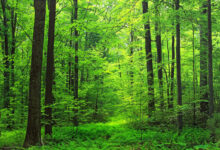
Another major source is Land Use Change and Deforestation. Forests act as critical carbon sinks, holding carbon in their biomass (trees) and soil.
Cutting down and burning forests releases stored carbon and simultaneously reduces the planet’s ability to absorb future atmospheric $CO_2$.
I. Cement Production
Even construction contributes, specifically through Cement Production. The process of heating limestone to produce clinker releases large amounts of embedded $CO_2$ as a chemical byproduct.
This industrial source represents a significant, though smaller, component of anthropogenic carbon emissions.
J. Overloading Ocean Sinks (Ocean Acidification)
The disruption is Overloading Ocean Sinks (Ocean Acidification). As the ocean absorbs more excess atmospheric $CO_2$, the dissolved gas reacts with water to form carbonic acid.
This process lowers the $\mathrm{pH}$ of seawater, threatening marine ecosystems, particularly shellfish and coral reefs that rely on calcium carbonate.
K. Agricultural Practices
Certain Agricultural Practices contribute through the release of potent non-$CO_2$ greenhouse gases. Nitrogen fertilizers can release nitrous oxide ($N_2O$), and livestock production releases methane ($CH_4$).
These gases, while less abundant than $CO_2$, have a much higher Global Warming Potential (GWP) over the short term.
3. Positive Feedback Loops: Accelerating Warming
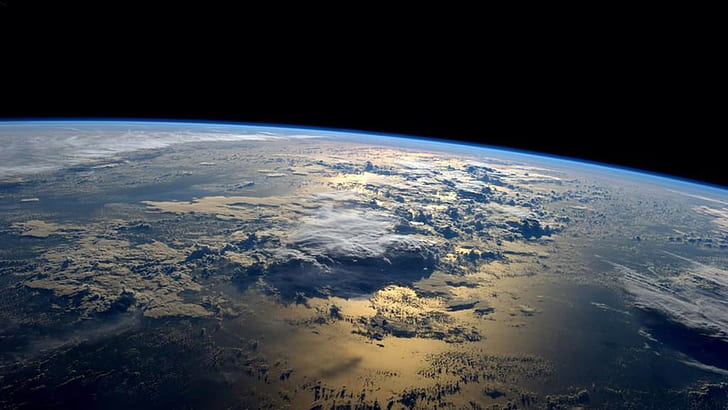
A positive feedback loop occurs when the result of a process (warming) amplifies the original process, leading to self-perpetuating, runaway climate change.
These positive loops threaten to push the climate system past dangerous tipping points.
L. Albedo Effect and Ice Melt
The most well-known loop is the Albedo Effect and Ice Melt. Ice and snow are highly reflective (high albedo), bouncing sunlight and heat back into space.
As the Earth warms, ice melts, exposing darker land and ocean surfaces, which absorb more solar energy.
M. Amplification of Warming
The increased absorption causes further melting and warming, initiating Amplification of Warming. This cycle is particularly strong in the Arctic, leading to a much faster rate of temperature rise there than the global average.
This continuous loss of reflective surface accelerates global heat accumulation.
N. Permafrost Thaw and Methane Release
A major concern is Permafrost Thaw and Methane Release. Permafrost, permanently frozen ground in the Arctic, contains vast stores of ancient organic carbon.
As the climate warms, the permafrost thaws, and microbes decompose the organic matter, releasing massive amounts of $CO_2$ and potent $CH_4$.
O. Hydrate Destabilization
Another potential geological source is Hydrate Destabilization. Methane hydrates are ice-like structures that trap methane gas under high pressure and low temperature on continental shelves.
Warming ocean waters could destabilize these hydrates, leading to catastrophic, rapid release of huge amounts of $CH_4$into the atmosphere.
P. Forest Dieback
The loop involving vegetation is Forest Dieback. Increased temperatures and prolonged droughts, driven by climate change, stress forests and increase the frequency and intensity of wildfires.
This dieback converts carbon sinks (living trees) into carbon sources (fires and decomposition), releasing carbon and reducing future absorption capacity.
4. Negative Feedback Loops: Natural Mitigation (Slowed)
A negative feedback loop is a self-regulating process where the result of a change works to reduce the magnitude of the original change, providing some natural stability to the climate system.
These loops are essential for stability, but human activity is currently overpowering them.
Q. Enhanced Photosynthesis
A natural stabilizing mechanism is Enhanced Photosynthesis. As atmospheric $CO_2$ concentrations rise, plants can increase their rate of photosynthesis (sometimes called the $CO_2$ fertilization effect).
This temporary increase in carbon uptake helps draw some of the excess $CO_2$ out of the atmosphere.
R. Limits of Fertilization
However, there are Limits of Fertilization. This benefit is constrained by other factors required for growth, such as water and nitrogen availability, which often decrease due to climate change impacts like drought.
The fertilization effect cannot keep pace with the current rate of anthropogenic emissions.
S. Cloud Feedback
The role of Cloud Feedback is complex and uncertain. Increased warming may lead to more water vapor in the atmosphere, potentially increasing cloud cover.
Low, bright clouds could reflect more sunlight, causing a cooling effect (negative feedback), but high, thin clouds could trap more heat (positive feedback).
T. Chemical Weathering
Over geological timescales, Chemical Weathering is the dominant negative feedback. Increased $CO_2$ leads to warmer, wetter conditions, which speed up the weathering of silicate rocks.
This weathering process draws $CO_2$ out of the atmosphere by creating bicarbonate ions that eventually precipitate as calcium carbonate rock on the seafloor.
U. Ocean Biological Pump
The Ocean Biological Pump is a vital negative feedback mechanism. Phytoplankton in the surface ocean absorb $CO_2$through photosynthesis.
When they die, they sink, carrying that carbon to the deep ocean floor, sequestering it for centuries or millennia.
5. Global Efforts and Mitigation Strategies
Addressing the Carbon Cycle Crisis requires not only reducing anthropogenic emissions but also actively supporting and enhancing natural carbon sinks to restore the pre-industrial balance.
Global action must focus on both cutting emissions and maximizing nature’s capacity to absorb carbon.
V. Decarbonization of Energy Systems
The most critical step is Decarbonization of Energy Systems. This involves rapidly transitioning away from fossil fuels to renewable and zero-carbon energy sources, such as solar, wind, and nuclear power.
Phasing out coal and internal combustion engines is the primary path to emission reduction.
W. Carbon Capture and Storage (CCS)
Carbon Capture and Storage (CCS) technologies aim to mitigate emissions from remaining industrial sources. CCS captures $CO_2$ at the source (like power plants) and injects it deep underground for permanent storage.
While controversial and costly, CCS is viewed as a necessary tool for industrial sectors that are difficult to decarbonize fully.
X. Nature-Based Solutions (NBS)
Nature-Based Solutions (NBS) involve protecting and restoring natural carbon sinks. Reforestation, afforestation (planting trees where they weren’t before), and protecting coastal ecosystems (blue carbon) enhance carbon absorption.
These solutions offer co-benefits like biodiversity restoration and improved water quality.
Y. Soil Carbon Sequestration
Innovative agricultural methods can maximize Soil Carbon Sequestration. Practices like no-till farming, cover cropping, and optimized grazing can enhance the soil’s ability to store carbon in the topsoil layer.
Healthy soils are not only better for crop yields but also act as a globally significant carbon reservoir.
Z. Policy and International Cooperation
Effective change requires robust Policy and International Cooperation. Agreements like the Paris Agreement set national targets (NDCs) to limit warming and coordinate global mitigation efforts.
Carbon pricing mechanisms and regulatory standards help incentivize the transition to a low-carbon economy.
Conclusion: The Race Against Tipping Points

The Carbon Cycle Crisis highlights the perilous consequences of human activity overwhelming the Earth’s ancient, delicate balance of carbon exchange. The rapid release of sequestered carbon through fossil fuel combustion and deforestation has severely overloaded the natural carbon sinks of the oceans and land.
This imbalance has triggered dangerous positive feedback loops, such as the albedo effect and ice melt, which relentlessly amplify warming by exposing darker surfaces to solar radiation. The most imminent threat arises from the potential for massive permafrost thaw and methane release, which could inject massive stores of potent greenhouse gases into the atmosphere.