

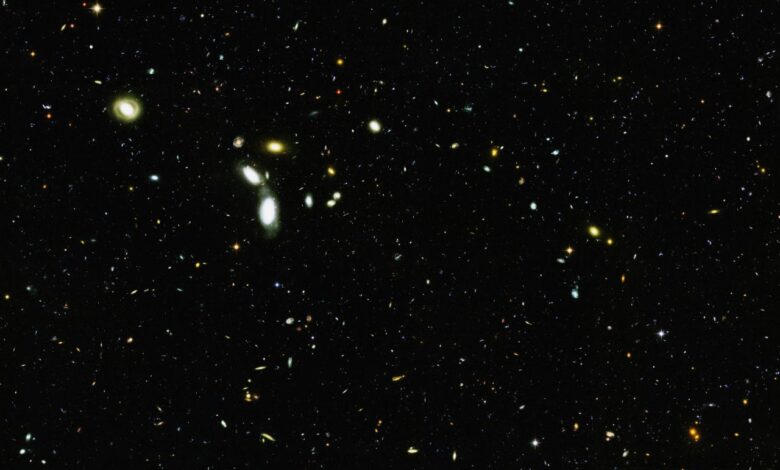
The quest to understand the invisible scaffolding of our cosmos has led astrophysicists to the most remote corners of time and space. Dark matter remains one of the greatest enigmas in modern science, yet it serves as the gravitational glue that allows galaxies to form and flourish.
By mapping the structures of the early universe, researchers are effectively looking at the skeletal remains of the Big Bang’s immediate aftermath. This process involves detecting subtle light distortions and fluctuations in the Cosmic Microwave Background that occurred billions of years ago.
Understanding how these invisible structures evolved helps us predict the ultimate fate of the universe and the expansion rate of space itself. As our technology improves, we are moving from theoretical models to high-resolution observations that challenge our fundamental understanding of physics.
The transition from a smooth, hot plasma to the complex web of filaments we see today is a story written in the shadows of dark matter. Through advanced computer simulations and deep-space telescopes, we are finally beginning to visualize the invisible forces that have shaped everything we know.
The Invisible Architect of the Cosmos
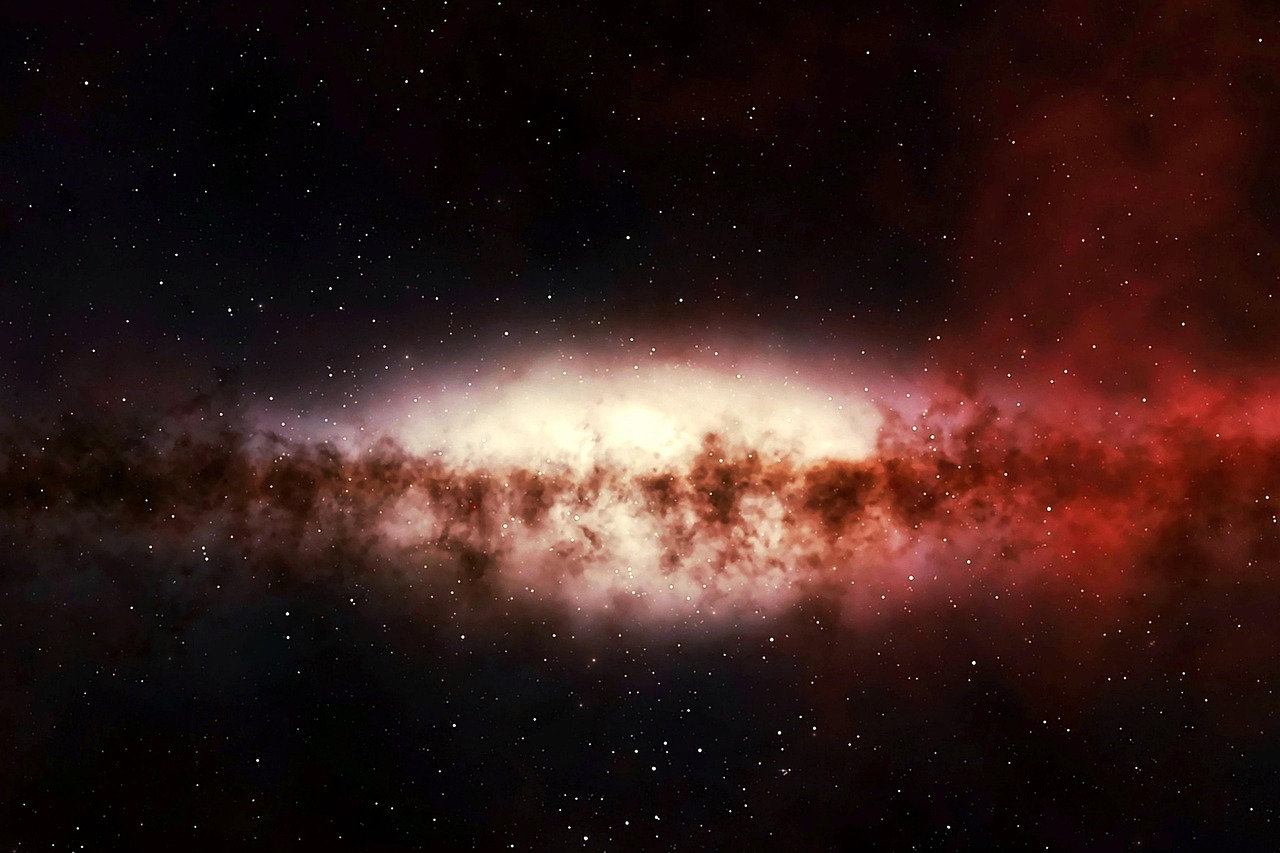
Dark matter does not emit, absorb, or reflect light, making it entirely invisible to traditional telescopes that rely on the electromagnetic spectrum. Its presence is only inferred through the gravitational influence it exerts on visible matter, such as stars and gas clouds.
A. Gravitational Lensing and Light Distortion






Massive concentrations of dark matter act like cosmic magnifying glasses, bending the light from distant galaxies as it passes by. By studying these distortions, scientists can create “mass maps” that show exactly where the invisible matter is located.
B. The Role of Cold Dark Matter (CDM)
The leading theory suggests that dark matter moves slowly compared to the speed of light, allowing it to clump together under gravity. These clumps formed the original “seeds” that attracted hydrogen gas to create the very first stars.
C. Baryonic Acoustic Oscillations
In the early universe, the tug-of-war between gravity and radiation pressure created sound waves that traveled through the hot plasma. These oscillations left a permanent imprint on the distribution of matter that we can still detect today.
Tracking the Cosmic Microwave Background (CMB)
The CMB is the oldest light in the universe, a faint afterglow from a time when the cosmos was just a few hundred thousand years old. It provides a snapshot of the initial density fluctuations that would eventually grow into large-scale structures.
A. Anisotropies and Density Fluctuations
Small temperature variations in the CMB reveal areas where the early universe was slightly more or less dense. The denser regions, dominated by dark matter, served as the gravitational pits into which regular matter eventually fell.
B. Polarization and Gravitational Waves
The way CMB light is polarized can tell us about the gravitational environment of the early universe. This data helps researchers distinguish between different theories of cosmic inflation and dark matter behavior.
C. The Integrated Sachs-Wolfe Effect
As CMB photons travel through evolving dark matter structures, they gain or lose energy depending on the gravitational potential. Mapping these energy shifts allows us to see how the cosmic web has grown and changed over billions of years.
Large-Scale Structure and the Cosmic Web
The universe is not a random collection of galaxies but a highly organized network known as the cosmic web. This web consists of vast filaments of dark matter connecting dense clusters, separated by enormous, empty voids.
A. Filamentary Growth and Galaxy Clusters
Dark matter naturally forms long, thread-like structures due to the way gravity works in three dimensions. Galaxies tend to form and migrate along these filaments, eventually congregating at the intersections where the gravity is strongest.
B. The Mystery of Cosmic Voids
Voids are the low-density regions between filaments that contain very little matter. By studying the shapes and sizes of these voids, cosmologists can test the strength of dark energy and its effect on the growth of structures.
C. Hierarchical Structure Formation
Cosmology follows a “bottom-up” approach where small halos of dark matter merge to form larger and larger structures. This process explains why we see small dwarf galaxies, massive spiral galaxies, and giant galaxy clusters in the modern sky.
Advanced Simulation and Numerical Modeling
Because we cannot see dark matter directly, we rely on massive supercomputer simulations to recreate the history of the universe. These “digital universes” allow us to test how different types of dark matter would change the cosmos.
A. N-Body Simulations and Particle Interaction
Scientists use millions of virtual particles to represent dark matter and calculate their gravitational interactions over billions of simulated years. These models are then compared to real-world observations to see if they match the patterns we see in the sky.
B. Hydrodynamic Modeling of Gas and Stars
While dark matter provides the gravity, regular gas provides the light. Hydrodynamic simulations track how gas cools, collapses, and ignites into stars within the dark matter halos, providing a complete picture of galaxy evolution.
C. Machine Learning in Cosmological Mapping
Artificial intelligence is now being used to scan through petabytes of telescope data to find the subtle signatures of dark matter. Machine learning algorithms can identify gravitational lensing patterns much faster than any human researcher.
The Search for the Dark Matter Particle
Mapping the structures is only half the battle; the other half is identifying what dark matter actually is. Several theoretical particles have been proposed, each with different implications for how the early universe formed.
A. Weakly Interacting Massive Particles (WIMPs)
WIMPs are the most popular candidates, as they fit perfectly into many extensions of the Standard Model of physics. If dark matter is a WIMP, it would produce specific patterns in the early universe that we are currently looking for.
B. Axions and Ultra-Light Dark Matter
Axions are much lighter than WIMPs and behave more like a wave than a particle. If axions make up the dark matter, they would create “fuzzy” structures in the early universe, preventing the formation of very small dark matter halos.
C. Sterile Neutrinos and Warm Dark Matter
Some theories suggest dark matter moves faster than the “cold” variety, which would wash out smaller structures. Mapping the smallest observable dark matter clumps helps scientists rule out or confirm these “warm” dark matter models.
Deep-Space Observatories and Future Missions
The next generation of telescopes is designed specifically to peel back the layers of the early universe. These instruments will provide the highest resolution maps of dark matter ever created.
A. The James Webb Space Telescope (JWST) Contributions
JWST can see the very first galaxies that formed inside dark matter halos. By observing these “first lights,” scientists can determine how quickly dark matter began clumping after the Big Bang.
B. Euclid and the Dark Energy Survey
The Euclid mission is specifically designed to map the geometry of the dark universe. It will observe billions of galaxies to measure the effects of gravitational lensing across a significant portion of the sky.
C. Ground-Based Vera C. Rubin Observatory
This observatory will conduct a ten-year survey of the sky, creating a “time-lapse” movie of the universe. This will allow researchers to see how dark matter structures influence the motion of visible matter in real-time.
The Intersection of Dark Matter and Dark Energy
While dark matter acts as an attractive force that clumps things together, dark energy acts as a repulsive force that pushes them apart. The history of the universe is a constant struggle between these two invisible giants.
A. The Era of Matter Domination
For several billion years after the Big Bang, dark matter was the dominant force, allowing the cosmic web to grow and solidify. During this time, the expansion of the universe was actually slowing down due to gravitational pull.
B. The Transition to Dark Energy Dominence
About five or six billion years ago, dark energy began to overtake dark matter as the primary force in the cosmos. This caused the expansion of the universe to accelerate, a discovery that shocked the scientific community.
C. The Fate of the Cosmic Web
As dark energy continues to push galaxies apart, the filaments of the cosmic web will eventually stretch and break. In the distant future, galaxies will become isolated islands in a vast, empty sea of expanding space.
Dark Matter in the Smallest Scales
While we often think of dark matter in terms of giant clusters, it also exists in small “sub-halos” that orbit within galaxies like our own Milky Way.
A. Detecting Sub-Halos through Stellar Streams
When a small dark matter clump passes through a stream of stars, it leaves a gravitational “wake.” By mapping these disturbances in our own galaxy, we can count the number of small dark matter structures that exist.
B. Dwarf Galaxy Populations and the “Missing Satellite” Problem
Standard models predict there should be thousands of small dark matter halos around the Milky Way, but we only see a few dozen dwarf galaxies. This discrepancy forces scientists to rethink how stars form in small gravitational wells.
C. Dark Matter Density in the Solar System
Researchers are even trying to measure the local density of dark matter in our own neighborhood. This is crucial for ground-based experiments that are trying to catch a dark matter particle as it passes through the Earth.
Impact of Dark Matter on Galactic Architecture
The shape and rotation of every galaxy are dictated by the massive dark matter “halo” that surrounds it. Without these halos, galaxies would fly apart as they rotate.
A. Rotational Curves and Missing Mass
Stars at the edges of galaxies move just as fast as stars near the center, which defies the laws of classical gravity unless there is an invisible mass providing extra pull. This observation was the first real evidence for the existence of dark matter.
B. The Stability of Spiral Arms
The beautiful spiral patterns we see in galaxies are actually quite unstable. Dark matter halos provide the structural rigidity needed to maintain these patterns over billions of years.
C. Galaxy Mergers and Dark Matter Stripping
When two galaxies collide, their dark matter halos merge first. In some cases, the regular matter can be stripped away, leaving behind “dark galaxies” that consist almost entirely of invisible matter.
Theoretical Challenges and Alternative Gravity
Some scientists wonder if dark matter is real at all, or if our understanding of gravity is simply wrong. While dark matter is the leading theory, alternative ideas continue to be explored.
A. Modified Newtonian Dynamics (MOND)
MOND suggests that gravity behaves differently at very low accelerations, such as those found at the edges of galaxies. While this theory explains some observations, it struggles to explain the large-scale structures seen in the CMB.
B. Emergent Gravity and Entropic Forces
Some theorists propose that gravity is not a fundamental force but an emergent property of quantum information. In this view, the effects we attribute to dark matter are actually the result of the universe’s information density.
C. Testing Gravity with Gravitational Waves
The detection of ripples in spacetime from merging black holes gives us a new way to test gravity. So far, every observation has supported Einstein’s General Relativity, which strongly points toward dark matter being a real substance.
Conclusion
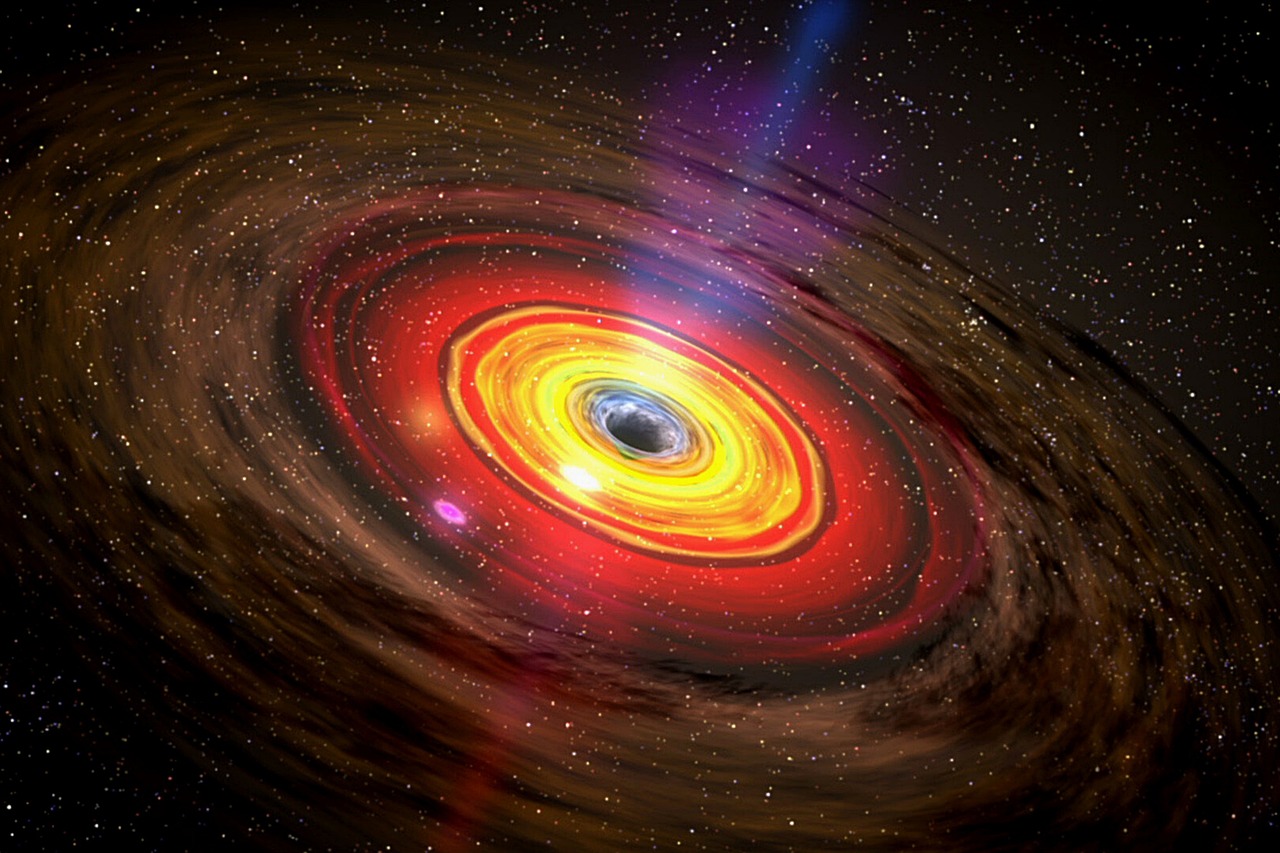
Mapping the dark matter structures of the early universe is the key to unlocking the history of everything we see. The cosmic web serves as the fundamental framework upon which all visible stars and galaxies are built.
Gravitational lensing remains our most powerful tool for visualizing the invisible mass that dominates the cosmos. Early density fluctuations in the hot plasma of the Big Bang provided the seeds for all future growth.
Computer simulations allow us to bridge the gap between abstract mathematical theories and physical observations. The struggle between the pull of dark matter and the push of dark energy defines the expansion of space.
Identifying the specific particle that makes up dark matter will be one of the greatest achievements in physics. New space telescopes are currently providing us with a high-resolution view of the first moments of structure formation. Without the gravitational stabilization of dark matter, the Milky Way and our solar system could not exist.
Alternative theories of gravity continue to be tested but have yet to replace the standard dark matter model. Understanding the voids between filaments is just as important as studying the dense clusters of the cosmic web.
Our journey to map the invisible is a testament to the power of human curiosity and scientific inquiry. As we look deeper into the past, we are essentially looking at the blueprints of the universe itself. The future of cosmology lies in our ability to see the shadows cast by the most mysterious substance in existence.